
Somewhere in your facility right now, a device you haven’t thought about in months is quietly connected to the internet. It’s doing its job. It’s also a door.
When most people picture a cyber attack, they picture a laptop, an email, a stolen password. They don’t picture a nurse call panel, a CCTV camera, or an environmental sensor humming away in a plant room. But every one of those connected devices sits on your network and every one of them is a way in.
Aged care providers hold some of the most sensitive information there is: resident health records, medication data, next-of-kin details, financial information. Protecting it used to be the IT department’s problem. It isn’t anymore. It’s a board-level responsibility and the attack surface has quietly grown far beyond the office computers.

Why Facility Technology Became a Target
The move to connected, real-time facility technology has been one of the best things to happen to aged care. It means faults are caught early, compliance evidence is gathered automatically, and staff spend less time chasing paperwork and more time with residents. We believe in it it’s what we do.
But connection cuts both ways. Every device that can send data can, in principle, receive it too. And unlike a laptop that gets patched and replaced every few years, facility hardware is often installed once and expected to run for a decade. That’s a long time for a device to sit on a network without anyone asking whether it’s still secure.
The risk isn’t the technology. It’s the technology no one is watching.
A connected device that’s monitored, maintained, and properly configured is an asset. The same device, forgotten and unpatched, is a liability. The difference isn’t the hardware it’s whether anyone is paying attention to it.
Attackers know this. They’re not always after the front door with the strong lock. They’re looking for the side window everyone forgot about — the default password never changed, the firmware never updated, the device installed by a contractor who left three years ago.
The Three Blind Spots Most Facilities Share
In our experience, the cyber risk in a facility rarely comes from a single dramatic weakness. It comes from a handful of quiet, common gaps that add up. Here are the three we see most often.
Forgotten Devices
Cameras, sensors, and panels installed years ago, still running default settings and outdated firmware. No one owns them, so no one secures them and no one notices until something goes wrong.
Flat Networks
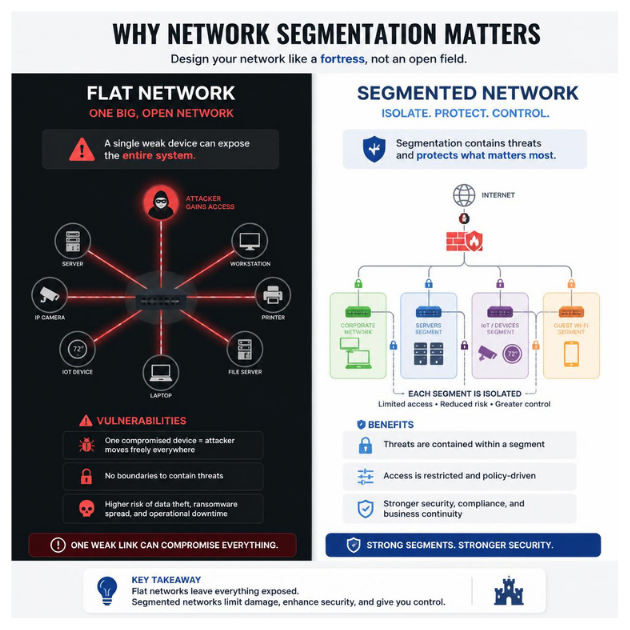
When facility devices share the same network as staff computers and resident data, a breach in one place can spread everywhere. One weak device shouldn’t put the whole facility at risk but on a flat network, it can.
No Clear Owner
IT owns the computers. Facilities owns the building. But who owns the connected nurse call system that sits between them? When responsibility is unclear, security falls through the cracks.
None of these are exotic. They’re the ordinary result of technology being added over time, by different people, for different reasons without anyone stepping back to look at the whole picture. Which is exactly the problem.
Why This Belongs in the Boardroom
It would be easy to read all this and file it under “something for IT to handle.” But the consequences of a facility cyber incident don’t stay in the server room. They land squarely on the executive team and the board.
A breach involving resident data isn’t just a technical failure it’s a breach of trust with the families who chose you, a potential reporting obligation, and a reputational risk that can take years to recover from. Under the strengthened obligations of the Aged Care Act 2024, providers are expected to demonstrate genuine governance over the systems that hold and move sensitive information.
“You can’t protect what you can’t see. The first step to securing a facility isn’t buying more technology it’s knowing every device that’s already connected.”
The good news is that the questions a board needs to ask aren’t technical. They’re about visibility, ownership, and accountability and any provider can start asking them today.
Five Questions Every Provider Should Be Able to Answer
You don’t need to be technical to test how exposed your facility is. If your team can answer these five questions clearly, you’re in good shape. If any of them draws a blank, that’s where to start.
- Do we have a complete, current list of every connected device across all our sites?
- Do we know who is responsible for keeping each of those devices updated and secure?
- Are our facility devices separated from the network that holds resident and staff data?
- Would we know within hours — not weeks if a device stopped behaving normally?
- If a supplier installed something years ago, do we still know how it’s configured and who can access it?
These aren’t trick questions. They’re the foundation of good governance and the same visibility that keeps a facility secure is the visibility that keeps it running well and audit-ready.
Visibility Is the Foundation
Everything we’ve talked about comes back to one idea: you can’t protect, maintain, or govern what you can’t see. That’s the principle real-time monitoring is built on and it’s why the same platform that catches a failing chiller before it breaks also gives you a clearer picture of what’s connected and how it’s behaving.
A single view of connected devices across every site, so nothing is forgotten
Continuous monitoring, so unusual behaviour is flagged early — not discovered late
A 24/7 Australian Response Centre watching over your facilities, around the clock
Australian-based support and infrastructure, so you always know where your data sits
Security and reliability are the same discipline.
The facilities that are hardest to breach tend to be the ones that are best run because both come from the same thing: knowing exactly what you have, watching it continuously, and acting fast when something changes. That’s the foundation we help providers build.
The connected facility is here to stay, and that’s a good thing. It makes care safer, compliance simpler, and operations calmer. But connection without visibility is a risk quietly waiting to surface.
You don’t have to choose between the benefits of smart technology and the security of your residents’ trust. You just have to be able to see what’s connected and make sure someone is always watching. That’s not just good cybersecurity. That’s good care.
Not sure what’s connected across your facilities?
Book a no-obligation discovery session and we’ll help you understand your current setup, where the blind spots are, and how real-time visibility keeps your facilities secure and audit-ready.
Book a Discovery Session →