
Ask anyone who runs an aged care facility what keeps them up at night, and it’s rarely the fault they can see. It’s the one they haven’t found yet.
A chiller quietly drifting out of range overnight. A nurse call point that will fail at exactly the wrong moment. A maintenance issue logged weeks ago, still sitting in a queue while the risk builds. None of it looks urgent today. All of it becomes urgent eventually usually on the day you can least afford it.
When something finally breaks, the repair invoice arrives and everyone treats that number as “the cost.” But the invoice is the tip of the iceberg. The real cost is everything sitting beneath the waterline the part your team carries long after the technician has packed up and gone home.
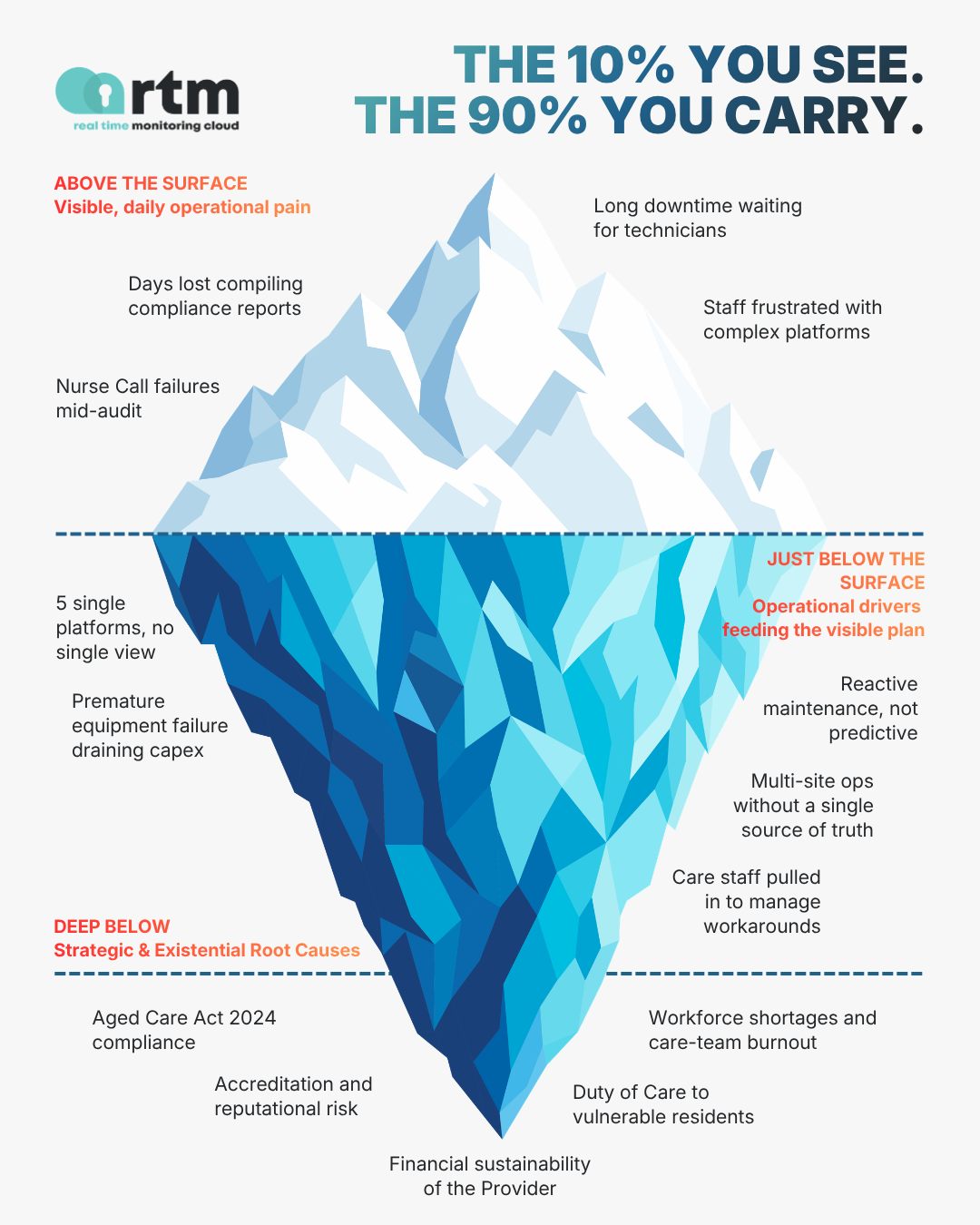
The 10% You See
Above the surface is the pain everyone can point to. The long wait for a technician to arrive on site. The days lost each month compiling compliance reports by hand. The nurse call failure discovered mid-audit. Staff quietly frustrated with platforms that were never built to talk to each other.
These are the visible symptoms the daily operational friction that shows up in your inbox and your incident log. They’re real, and they hurt. But they’re also the smallest part of the story.
Because every one of those visible problems is being fed by something larger underneath it.
Just Below the Surface
Dip beneath the waterline and you find the operational drivers the reasons the visible problems keep happening. This is where a reactive environment really shows its shape.
Maintenance that responds to failure instead of predicting it. Multiple standalone platforms with no single view, so no one can see the whole picture at once. Multi-site operations running without a shared source of truth. And care staff the people you hired to look after residents — quietly pulled in to manage the workarounds that keep it all limping along.
Reactive isn’t a strategy. It’s a series of surprises.
When your systems only tell you something’s wrong after it has already gone wrong, every fault becomes an interruption, every audit becomes a scramble, and every fix costs more than it needed to. The problem was never the equipment. It was the fact that no one was watching it in real time.
This is the layer where cost quietly compounds. Premature equipment failure drains capital that was meant to last years. Reactive callouts add up. And the hours your team spends reconciling records across disconnected systems never appear on any invoice but they’re being paid for all the same.
The Deep Below: What Reactive Really Costs
At the very bottom of the iceberg sit the things no facility manager wants to say out loud the strategic and existential risks that a reactive environment feeds directly into. Let’s be honest about what’s carried down here.
Financial
Premature equipment failure and reactive callouts erode capital budgets. Every fault handled the slow, manual way carries a labour cost that never shows up as a line item — but it’s paid for in your team’s time and your bottom line.
Operational
Workforce shortages and care-team burnout worsen every time staff are diverted to chase workarounds. A reactive environment quietly taxes the people you can least afford to lose.
Reputational
Accreditation and duty-of-care obligations don’t pause for a system outage. A single failure in front of a resident, a family, or a regulator can undo years of hard-earned trust.
This is the 90% you carry. It never appears on the repair bill, but it shapes every conversation you have with your board, your regulators, and the families who trust you with the people they love.
Turning the Iceberg Transparent
Here’s the part worth holding onto: none of this is inevitable. The providers who’ve stopped losing sleep didn’t hire more technicians or buy more spreadsheets. They changed what they could see.
“You can’t manage the risk you can’t see. Real-time monitoring doesn’t just fix faults faster — it makes the 90% beneath the surface visible before it becomes a crisis.”
When a facility moves from reactive to real-time, the shift looks like this:
- Environmental and equipment conditions monitored continuously, so a fault is flagged before it becomes a failure
- Issues resolved remotely wherever possible RTM Cloud resolves over 98% of issues without a site visit
- A single source of truth across every site, so leadership sees the whole picture and site teams see what’s relevant to them
- A 24/7 Australian Response Centre watching over your facilities, so no one on your team has to be the alarm system
- Audit-ready evidence gathered as you go not reconstructed in a panic the week before an inspection
The difference isn’t just faster fixes. It’s a fundamentally calmer operation one where the surprises stop, the capital lasts longer, and the care team gets to focus on care.
What This Looks Like in the Real World
This isn’t theory. It’s the difference real-time monitoring makes for providers already living it every day:
Faults are caught and resolved before residents or staff ever notice them
Equipment lasts longer because it’s maintained on condition, not on failure
Care staff stay focused on residents instead of chasing workarounds
Audits become a demonstration of good governance, not a source of dread
The proof is in the numbers.
Across 90 sites, Opal Healthcare saves an estimated $270,000 every year with RTM Cloud around $3,000 per site, per year. That’s what happens when the iceberg becomes transparent: the cost you used to carry quietly turns into value you can measure.
The failures that damage providers and exhaust good teams are rarely the ones you can see coming. They’re the ones nobody was watching.
The good news is that you don’t have to keep carrying the 90%. With real-time monitoring, what used to live beneath the surface comes into full view early enough to act, calmly enough to plan. That’s not just fewer breakdowns. That’s a provider in control of its own future.
See what’s really beneath the surface of your Facilities
Book a no-obligation session with the RTM Cloud team and we’ll walk through your current setup and show you where real-time monitoring would save you the most.
Book a Discovery Session →